BMW’s 2012 M5 F10: Twin-Turbo V8 and Seven-Speed DCT Detailed
The fifth-generation BMW M5 F10 combines a 560hp twin-turbo V8 with a new seven-speed double clutch transmission and an electronically controlled differential.
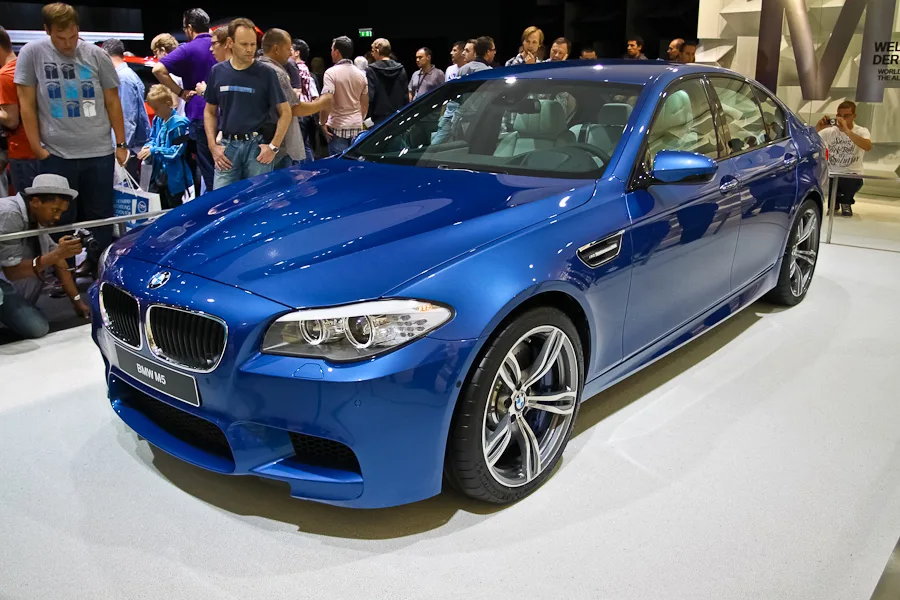
BMW’s F10-generation M5, launched for 2012, introduced a new drivetrain that moved the super saloon formula towards turbocharging and advanced electronics. The heart of the car is the S63 4.4-litre twin-turbocharged V8, which replaced the naturally aspirated V10 of the previous E60 M5.
S63 engine: twin-turbo power and efficiency
The S63 engine delivers 560hp and 680Nm of torque, making it the most powerful production engine fitted to an M5 at launch. Peak torque arrives early, from 1,500rpm and holds through to 5,750rpm. BMW achieved this with a pair of turbochargers mounted within the V of the engine, a layout that shortens intake and exhaust paths. This integration allows the exhaust gases from cylinders on both banks to be combined with minimal interference, feeding twin-scroll turbos for a continuous and efficient flow.
The engine incorporates BMW’s Valvetronic system, which varies the intake valve lift to control airflow directly, improving throttle response and reducing pumping losses. The result is a claimed average fuel consumption of 9.9 litres per 100km on the EU cycle, a notable figure for a 560hp saloon. The exhaust system routes gases directly from the turbochargers to the catalytic converters, minimising back pressure and improving efficiency.
Seven-speed double clutch transmission
Power is sent to the rear wheels via a seven-speed double clutch transmission (DCT). The DCT uses two clutches: one for gears 2, 4 and 6, and another for 1, 3, 5, 7 and reverse. This arrangement allows pre-selection of the next gear, enabling rapid and smooth shifts without interrupting power delivery. Drivers can choose between manual and automatic modes, with several shift programs ranging from economy to maximum performance.
The transmission’s core is a mechatronic module containing sensors for pressure, velocity and gear position. This technology ensures precise control and quick adaptation to the driver’s inputs or changing conditions.
Active rear differential and chassis upgrades
BMW introduced an electronically controlled limited slip rear differential for the F10 M5. Unlike the previous generation’s mechanical system, the new diff uses an electric motor to lock from zero to 100 percent within fractions of a second. The system reacts to data such as engine speed, vehicle speed and yaw rate, allowing proactive torque distribution and improved traction during cornering or acceleration.
Braking is managed by M compound brakes, with 400mm vented steel discs and six-piston fixed calipers at the front. The chassis is tuned for both high-speed stability and everyday comfort, reflecting the M5’s dual role as a business saloon and a performance car.
Performance and pricing
BMW claims the F10 M5 accelerates from 0 to 100km/h in 4.4 seconds and reaches 200km/h in 13 seconds. Top speed is electronically limited to 250km/h. At launch, the car carried a price tag of €102,700 in Germany.
For a detailed look at how BMW’s 2012 model year changes affected the M5 and other models, see BMW Details 2012 Model Year Equipment Changes Across Range.