Hyundai Tucson debuts at 2015 Geneva Motor Show with hybrid variants
Hyundai has launched the new Tucson SUV at Geneva, marking a return to the nameplate in Europe and introducing both 48V hybrid and plug-in hybrid concepts.
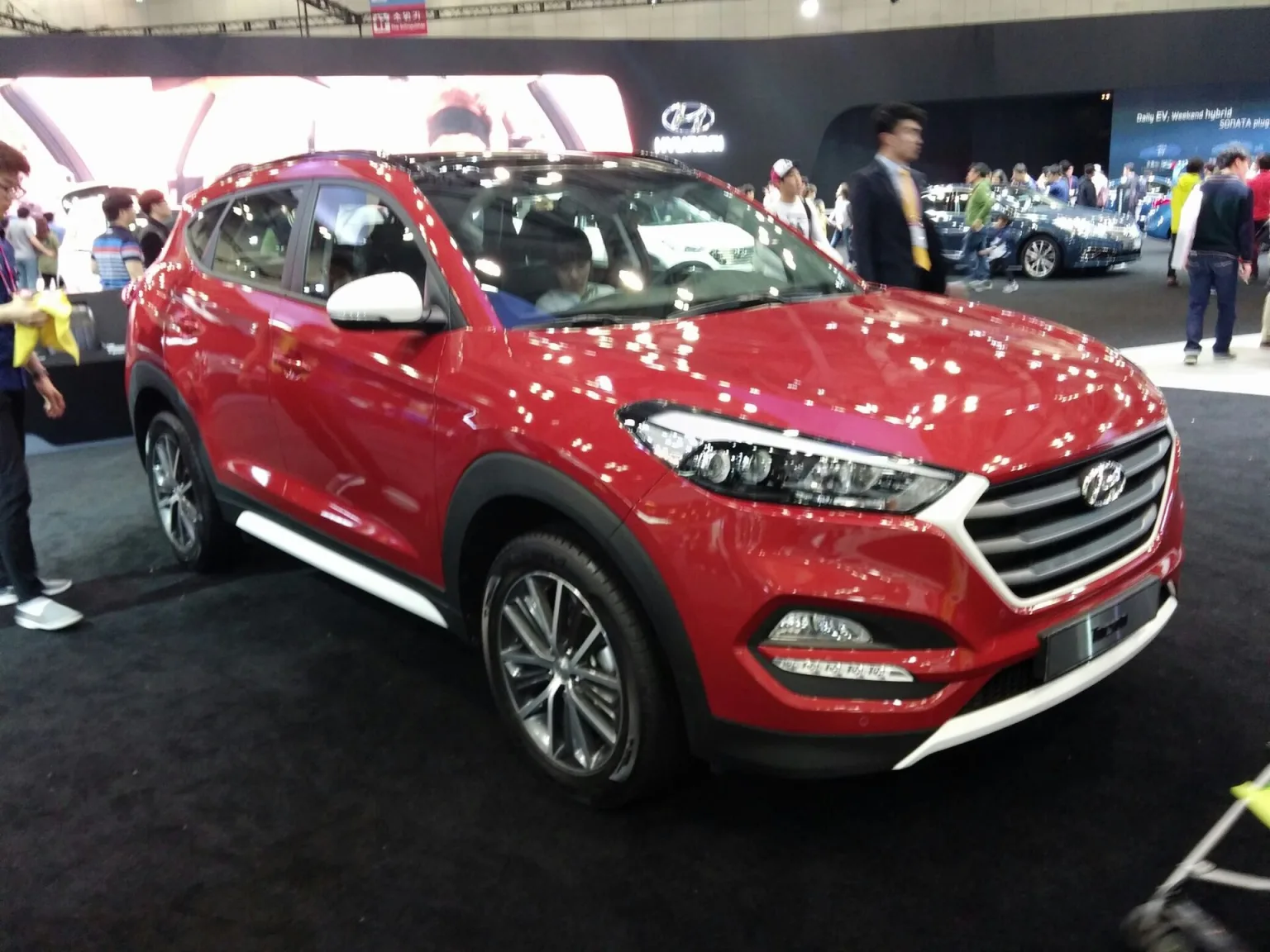
Hyundai has unveiled the all-new Tucson at the 2015 Geneva Motor Show, marking a generational change and a return to the Tucson name for European markets. The new compact SUV arrives with a broader range of powertrains, including traditional petrol and diesel engines, a 48V hybrid concept and a plug-in hybrid concept.
The Tucson replaces the ix35 badge in Europe, aligning the model name with global markets. Its exterior adopts Hyundai’s latest design language, with a prominent hexagonal grille, LED headlights and styling cues drawn from the larger Santa Fe. Inside, Hyundai has focused on raising perceived quality, introducing more soft-touch materials, a large touchscreen display and options such as heated and ventilated front seats.
Boot capacity stands at 513 litres, and an electrically assisted tailgate is available. Hyundai has also equipped the Tucson with a suite of safety and driver assistance features, including lane keeping assist, autonomous emergency braking and blind spot detection.
Engine range and hybrid concepts
The new Tucson’s engine line-up includes a naturally aspirated 1.6-litre petrol with 135 hp paired to a six-speed manual, and a turbocharged 1.6-litre petrol producing 176 hp, available with an optional seven-speed dual-clutch transmission. Diesel options start with a 1.7-litre CRDi delivering 115 hp, while the 2.0-litre diesel is offered in 136 hp and 184 hp versions, the latter available with a six-speed automatic.
- 1.6-litre petrol (135 hp, manual)
- 1.6-litre turbo petrol (176 hp, 7-speed DCT optional)
- 1.7-litre CRDi diesel (115 hp)
- 2.0-litre diesel (136 hp or 184 hp, auto optional)
Hyundai also presented two hybrid concepts. The 48V hybrid pairs the 136 hp 2.0-litre diesel with a 14 hp electric motor, producing a combined 150 hp and 413 Nm of torque, with CO2 emissions of 109 g/km. The plug-in hybrid concept mates the 115 hp 1.7-litre diesel to a rear-mounted 68 hp electric motor and a 10.7 kWh lithium-ion polymer battery, giving a claimed electric-only range of 50 km and combined output of 183 hp and 474 Nm. CO2 emissions for the plug-in hybrid are quoted at just 48 g/km.
Positioning and competition
By reverting to the Tucson name and introducing hybrid options, Hyundai is aiming to strengthen its position in the competitive C-segment SUV market. The design and technology upgrades are intended to attract buyers seeking more premium features and lower emissions. The Tucson will compete directly with models such as the Volkswagen Tiguan and Nissan Qashqai, both of which have strong footholds in Europe. For more on the previous generation, see Hyundai ix35 facelift revealed at 2013 Geneva Motor Show
Production models are expected to arrive in showrooms later in 2015, with specifications and pricing to be confirmed for each market closer to launch.