Porsche 918 Spyder Crashed on Autobahn Near Stuttgart
A Porsche 918 Spyder was involved in an accident on a wet stretch of German Autobahn near Stuttgart, with early reports suggesting the driver was a professional test driver.
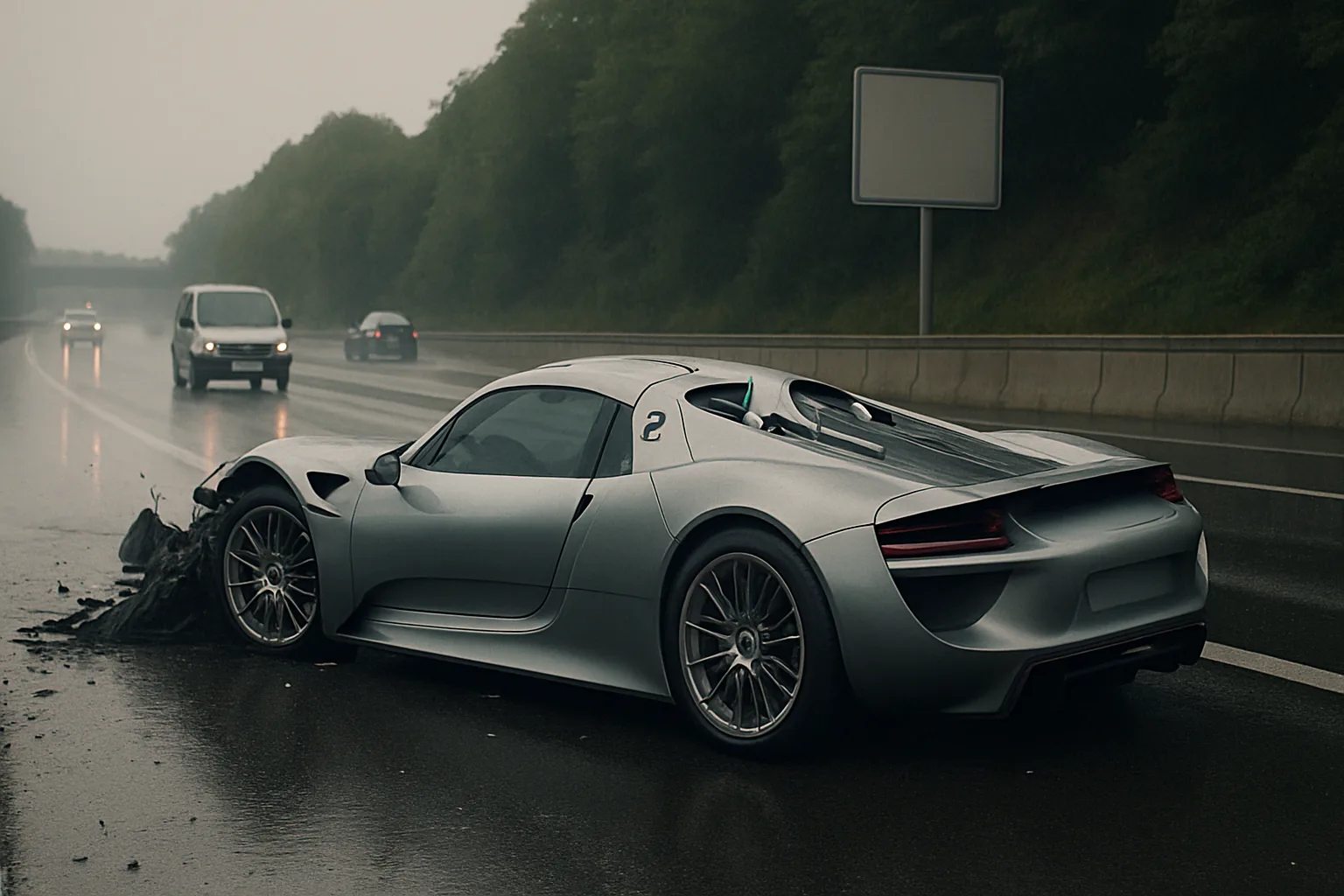
A Porsche 918 Spyder was crashed on the Autobahn near Stuttgart, Germany, in November 2013. The incident involved a new example of Porsche’s hybrid supercar. Early reports indicated that the driver was likely a professional test driver rather than a private owner, and the accident occurred in poor weather conditions.
Images from the scene showed emergency services attending, including an ambulance. The precise cause of the crash was not officially confirmed, but wet road conditions were reported. There was no immediate information on the extent of injuries, if any, to the driver or others involved.
Porsche 918 Spyder: Hybrid Supercar
The 918 Spyder was Porsche’s flagship at the time, combining a 4.6-litre naturally aspirated V8 with two electric motors, one on each axle. The total system output was 887hp (652kW) and up to 1,289Nm of torque, delivered through a seven-speed dual-clutch transmission. Porsche quoted a 0-60mph time of 2.7 seconds and 0-200km/h in 7.2 seconds. The car was part of a new wave of hybrid hypercars alongside the LaFerrari and McLaren P1.
| Engine | 4.6-litre V8, naturally aspirated |
|---|---|
| Electric motors | Two (front and rear axle) |
| Total power output | 887hp (652kW) |
| Torque | Up to 1,289Nm |
| Transmission | 7-speed dual-clutch |
| 0-60mph | 2.7 seconds |
| 0-200km/h | 7.2 seconds |
First reported crash for the 918 Spyder
At the time, this incident was believed to be the first reported crash involving a Porsche 918 Spyder. The car had only recently begun customer deliveries, making any accident newsworthy for collectors and enthusiasts. The 918 Spyder’s hybrid drivetrain and advanced chassis systems were designed for extreme performance, but as with any high-powered supercar, loss of control remains a risk, especially in challenging weather.
Rarity and collector interest
The 918 Spyder was produced in limited numbers, with Porsche later confirming more than 600 units sold worldwide. Any accident involving the model attracts attention due to its rarity and high value on the secondary market. Damaged cars can still command strong interest from collectors, depending on repair history and originality. For more on the model’s market, seeour coverage of a Voodoo Blue Porsche 918 Spyder for sale.
Supercar crashes and insurance
Incidents involving high-value supercars like the 918 Spyder often raise questions about insurance coverage, repair costs and the future value of the car. Specialist insurers typically handle such claims, and the complexity of hybrid systems can make repairs challenging and expensive. The 918 Spyder’s carbon-fibre monocoque and bespoke components mean that even minor accidents may require factory involvement for proper restoration. For comparison, seeour report on a Ferrari F12 Berlinetta crash in Morocco.
At the time of the crash, Porsche had not issued an official statement on the incident. As with most supercar accidents, the car’s future would depend on the extent of the damage and the owner’s decision to repair or sell.